


Water Scarcity and Its Impact on Industry
The impact of water scarcity on industry: Environmental, economic and operational pressure
Water scarcity affects water availability, source quality and the operating conditions of water-dependent sectors. It creates pressure across ecosystems, economies, communities and industrial operations.
For industrial operators, these wider impacts become relevant when they reduce source reliability, change available water quality, increase discharge pressure or limit access to freshwater. In these conditions, water scarcity becomes an operational exposure, not only an environmental issue.
For a practical framework on how industrial sites can assess treatment capacity, source flexibility and changing feedwater conditions, read the Water Scarcity at Industrial Sites Guide.
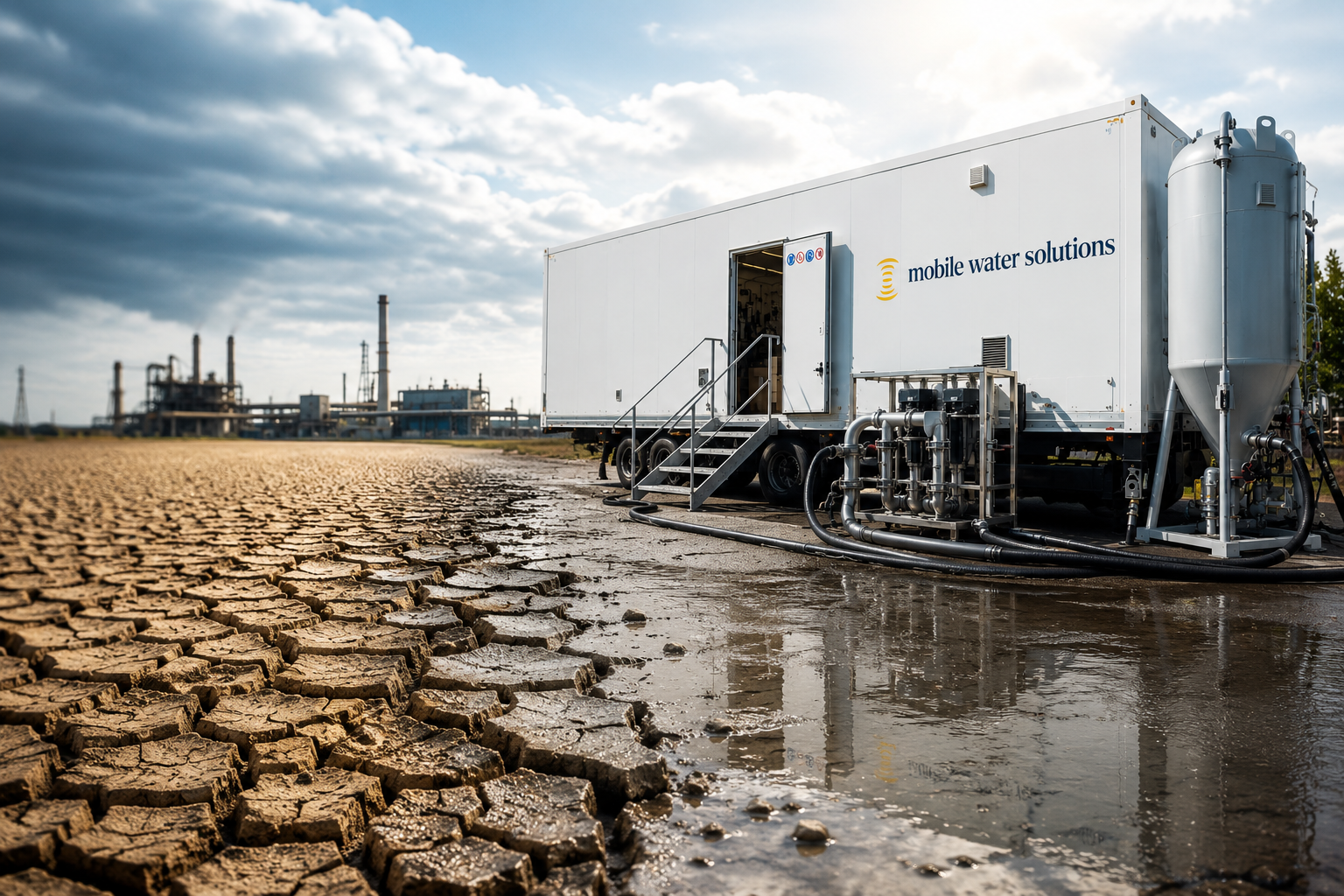
Environmental pressure: reduced flows and lower source quality
Water scarcity places pressure on natural ecosystems. Reduced river flows, shrinking lakes and drying wetlands can damage habitats, reduce biodiversity and affect aquatic species.
Lower water volumes also reduce dilution capacity. With less water available to dilute waste, pollutants can become more concentrated in rivers, lakes and groundwater sources. For industrial users, this can make available water harder to treat and less reliable as a source.
This is where environmental pressure can become an operational constraint: source water quality changes, treatment requirements increase and existing infrastructure may face higher contaminant loads.
Economic pressure: disruption across water-dependent sectors
Water scarcity creates economic exposure because many sectors depend on reliable water access. Agriculture, energy production, manufacturing, mining, food and beverage, refining, chemicals, pulp and paper and other water-intensive operations can all be affected when water availability decreases or quality becomes more variable.
The cost of water scarcity is not limited to the price of water. It can include higher treatment costs, increased wastewater management requirements, production delays, reduced productivity and compliance exposure.
For industrial sites, water-related disruption becomes material when it affects process water, boiler feed, cooling, cleaning, wastewater treatment or discharge management.
Social and regulatory pressure: increased scrutiny over water use
Water scarcity can intensify competition between domestic use, agriculture and industry, especially in regions where access to water is already constrained.
It can also increase public and regulatory scrutiny over abstraction, wastewater discharge and industrial water use. Where water is scarce, industrial operators may face tighter limits, stricter discharge requirements or stronger expectations around responsible water management.
For operators, this means water scarcity can affect both site operations and licence to operate.
Why this matters for industrial operators
Industrial sites do not only need water. They need water that can be accessed, treated and used at the required quality, flow rate and reliability.
When water scarcity changes source conditions, operators need to assess:
- which water sources are available
- how feedwater quality is changing
- whether existing treatment infrastructure can manage the variation
- where freshwater dependency can be reduced
- whether wastewater or alternative sources can be reused where technically viable
- where additional or temporary treatment capacity may be required
These questions are operational, not theoretical.
For the practical next step, read the Water Scarcity at Industrial Sites Guide. It explains how changing feedwater conditions affect industrial water treatment and where Mobile Water Solutions can support treatment capacity, source flexibility and continuity.