

Overcoming Water Scarcity Guide For Industrial Operators
Water scarcity at industrial sites: mobile water solutions for changing feedwater conditions
Reduce the impact of water shortages with mobile water treatment solutions configured for variable feedwater quality, alternative sources and operational continuity.
Industrial water treatment systems in water-intensive sectors are increasingly affected by water scarcity, reduced source reliability and changing feedwater quality.
Water scarcity is already a material global constraint, with nearly half of the world’s population facing severe water scarcity for at least part of the year. Water-intensive sectors are directly exposed: agriculture (which accounts for 70% of freshwater withdrawals), industry (just under 20%), and municipal or domestic use (around 12%).
In industrial operations, water treatment is a production-critical function. Water scarcity-related conditions such as drought, reduced rainfall, groundwater over-extraction, pollution, increased salinity, higher chloride levels, elevated conductivity and suspended solids can reduce treatment reliability over time.
The main operational constraint is the inability of fixed water treatment infrastructure to adapt quickly to reduced source availability or changing feedwater quality. Mobile Water Solutions addresses this constraint by providing temporary or supplementary treatment capacity, enabling industrial sites to treat variable feedwater, support alternative sources and maintain continuous industrial water supply.
Assess where water scarcity can affect continuity, treatment capacity and freshwater dependency.
Contact our local team to discuss your project.
Talk to An Expert
What is Water Scarcity?
Water scarcity is a seasonal, annual, or multi-annual water-stress condition in which demand for water exceeds available supply, either in terms of quantity or quality.
It can result from two main constraints: unavailability and inaccessibility.
Unavailability refers to physical scarcity. Freshwater resources may be insufficient because of population growth, pollution, over-extraction of groundwater, agricultural demand, industrial water use, prolonged droughts, floods or declining rainfall patterns.
Inaccessibility refers to economic scarcity. Water may be present in the environment but cannot be effectively accessed, treated or distributed. This is often due to ageing or insufficient infrastructure, poor maintenance or lack of investment.
For industrial sites, both constraints create the same practical issue: water must still be treated to the required quality, at the required flow rate, for the required application.
What is the Impact of Water Scarcity?
Water scarcity affects ecosystems, economies, communities and industrial operations. For industrial sites, these wider impacts become operationally relevant when they reduce source reliability, increase feedwater variability, tighten discharge requirements or limit access to freshwater.
Environmental pressure increases when reduced river flows, shrinking lakes and drying wetlands reduce ecosystem stability and increase pollutant concentration in available water sources. With less water available to dilute waste, pollutants become more concentrated, making some sources harder to treat and less reliable for industrial use.
Economic exposure also increases. In low- and lower-middle-income countries, 70–80% of jobs rely on water, particularly in agriculture. Even in high-income regions, drought-related water scarcity caused estimated losses of €2 to €9 billion across Europe, affecting sectors from agriculture to energy production.
Water scarcity also creates social pressure. Globally, water stress is linked to approximately 10% of migration flows, as communities are affected by failing crops, dried-up water sources or worsening living conditions.
In 2019, 38% of the EU population and nearly a third of EU territory experienced the negative effects of water scarcity, particularly in southern Europe. For industrial operators, this type of pressure can translate into tighter abstraction limits, stricter discharge requirements and increased scrutiny over water use.
Why does water scarcity increase industrial water treatment risk?
As water availability decreases or feedwater quality changes, operational risk increases due to combined source, treatment and compliance constraints.
Most facilities may experience:
- reduced intake from surface water, groundwater or municipal supply
- changing feedwater quality caused by drought or overuse
- increased salinity, chloride or conductivity
- higher suspended solids or contaminant loads
- reduced reliability of existing treatment systems
- tighter discharge requirements
- increased need for wastewater treatment or water reuse
- limited flexibility to maintain process water, boiler feed or cooling water supply
Industry has a direct dependency on freshwater. Seven major sectors — food, textiles, energy, industry, chemicals, pharmaceuticals and mining — are responsible for 70% of the world’s freshwater use, often returning water contaminated with chemicals and further reducing its availability.
A six-year survey of over 16,000 formal firms in more than 100 economies found that each additional water outage in a typical month caused an average sales loss of 8.7%. The impact is higher where infrastructure is limited or where alternative water sources are difficult to access.
“Besides reducing water availability, water scarcity reduces source reliability, which becomes a key limiting factor in industrial continuity planning.”
A practical checklist to help evaluate your site's preparedness for water scarcity.
Download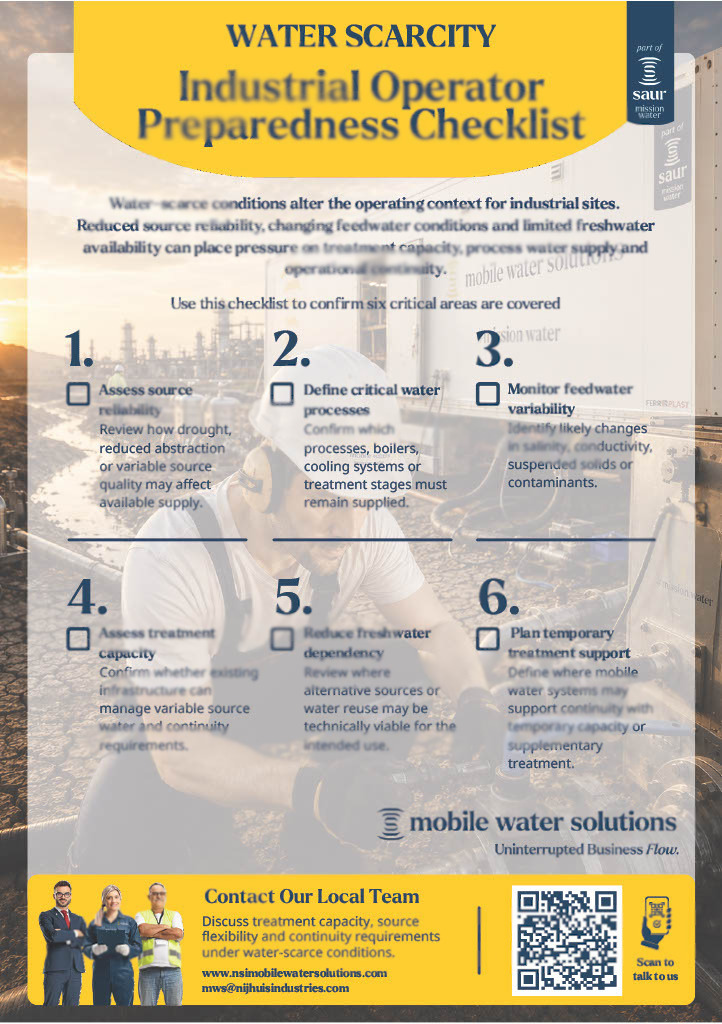
How mobile water systems are deployed during water scarcity
Mobile water systems are modular, containerised or skid-mounted treatment units designed to temporarily replace, supplement or support industrial water treatment capacity when permanent infrastructure cannot manage reduced source availability, variable feedwater quality or temporary reuse requirements.
In water scarcity conditions, their use is driven by reduced control over the water supply chain. As freshwater dependency increases and source quality becomes less stable, available water may no longer meet the required quality, volume or reliability for production-critical applications.
Mobile water systems are deployed as temporary process infrastructure to maintain compliant treated water supply while sites manage changing feedwater conditions, alternative water sources, wastewater treatmentor reuse requirements. Their function is to reduce dependency on fixed infrastructure when water scarcity creates conditions outside normal operating parameters.
Deployment typically occurs when water scarcity creates operational exposure in industries such as food and beverage, power generation, mining, chemicals, pharmaceuticals, pulp and paper, refining and manufacturing.
Typical triggers include:
- drought or overuse affecting surface water or borehole water quality
- reduced freshwater availability
- increased salinity, chloride, conductivity or suspended solids
- temporary source changes or contamination events
- seasonal demand increases
- wastewater treatment or reuse requirements
- planned maintenance or refurbishment during water-constrained periods
- unexpected breakdowns or emergency events
- pilot testing before permanent infrastructure is considered
Across these scenarios, the operational priority is to maintain treated water supply as source reliability decreases and feedwater conditions become more variable.
How mobile water systems maintain continuity under changing feedwater conditions
When water scarcity affects a site, the treatment requirement may change before the site faces a complete shortage of water.
Available source water may contain higher salinity, elevated conductivity, more suspended solids, higher chloride levels or additional contaminants. These changes can disrupt existing treatment performance and affect product quality or downstream operations.
A mobile water system provides temporary or supplementary treatment capacity within the process train. The system is connected according to site configuration and treats the available water source to meet the required specification for downstream users such as boilers, process units, cooling systems or reuse applications.
This allows the site to maintain treated water supply while managing reduced freshwater availability, changing feedwater quality or temporary reuse requirements.
Temporary treatment capacity can support continuity while sites manage changing feedwater quality, reduced freshwater availability or reuse requirements. Throughout deployment and operation, flow rate, feedwater quality, treated water specification and operational demand must remain aligned.
How are mobile systems integrated when feedwater conditions change?
Integration depends on source water quality, treatment requirement, site hydraulics and intended use. Three configurations are commonly used:
- Variable feedwater support
Mobile systems are used to treat feedwater affected by scarcity-related quality changes, including increased salinity, conductivity, chloride, suspended solids or contaminants.
- Alternative source treatment
Mobile systems treat water from sources such as surface water, borehole water, rainwater, brackish groundwater, seawater or wastewater where freshwater availability is constrained.
- Reuse support mode
Mobile systems support wastewater treatment and water reuse applications where treated water can reduce freshwater demand and discharge volumes.
All configurations require control of:
- flow rate compatibility
- feedwater quality variation
- treated water specification
- discharge or reuse requirements
- continuity of downstream supply
What is the cost of water-related disruption in industrial operations?
Water scarcity affects industrial operations because water is required for process water, boiler feed, cooling water, cleaning, wastewater treatment and discharge management.
Reduced water availability can create production delays, higher treatment requirements, increased disposal costs and compliance exposure. Increased pollution also means companies may face growing costs for water treatment, compliance with environmental standards and potential fines.
In some regions, inadequate industrial water use has led to factory closures, public protests or loss of market access due to non-compliance with international sustainability standards.
For industrial sites, the cost of water-related disruption is not limited to water procurement. It includes production continuity, treatment reliability, discharge compliance and the ability to maintain required water quality under changing source conditions.
Reducing water scarcity exposure with treatment and reuse
Effective water treatment and wastewater treatment and water reuse technologies can reduce exposure to water scarcity by improving control over available water sources.
Water treatment helps sites adapt to changing feedwater conditions, including fluctuations in quality and availability caused by droughts or overuse of freshwater sources. Advanced treatment processes can handle variable or lower-quality feedwater where the required treated water specification can be achieved.
Water reuse, or water recycling, reduces freshwater demand by reclaiming water from sources such as wastewater, greywater, rainwater, borehole water or desalinated seawater. By treating this water appropriately and using it again in suitable applications, industrial sites can reduce dependency on stressed freshwater supplies.
Water reuse can support:
- reduced pressure on freshwater supplies
- lower operational costs and environmental impacts
- improved water security in drought-prone areas
- improved compliance with environmental regulations
Water reuse is already implemented in different industrial applications:
- Process water recycling: in manufacturing and food processing, treated rinse water or cleaning water can be reused in non-critical stages, reducing intake and discharge.
- Cooling and boiler water loops: cooling tower blowdown and boiler condensate can be treated and reused on site.
- Borehole water purification: in regions with poor-quality groundwater, filtration, softening and reverse osmosis systems can enable controlled industrial water use.
The treatment process must be selected according to feedwater quality, contaminants present, required treated water specification and intended use.
Key water and wastewater treatment technologies include:
- Filtration and ultrafiltration to remove solids and microbes
- Reverse osmosis, including seawater RO, to remove salts and dissolved impurities
- Deionisation and degassing for high-purity industrial applications
- Clarification and softening to reduce turbidity and hardness
- Dissolved air flotation (DAF) to separate oils and suspended solids
- Desalination to remove salts and minerals from seawater and brackish groundwater
Technology selection should follow the operational constraint: source quality, flow rate, treatment requirement, reuse objective and continuity risk.
What is the operational value of mobile systems under water scarcity conditions?
Mobile water systems provide temporary or supplementary treatment capacity where water scarcity affects source reliability, feedwater quality or freshwater dependency.
This reduces exposure to production disruption associated with reduced water availability, variable feedwater quality or temporary water source changes.
Key benefits:
- variable feedwater can be treated under controlled conditions
- alternative water sources can be assessed and treated where technically viable
- wastewater treatment and reuse can reduce freshwater dependency
- downstream production remains supplied with treated water
- seasonal or intermittent scarcity can be managed without immediate permanent infrastructure
- pilot projects can be tested under real operating conditions before capital investment
- facilities can maintain support during planned maintenance, refurbishment, unexpected breakdowns or emergency events
- remote or hard-to-reach locations can be supported where access is limited by geography, infrastructure or emergency conditions
Mobile Water Solutions’ mobile treatment units are pre-packaged on trailers, skids or containers to support rapid setup. They can treat from 1 to 1,000 cubic metres per hour of process water, wastewater or water for reuse, using technologies including ultrafiltration, reverse osmosis, deionisation, clarification and softening.
For operators, mobile assets provide a practical route to water resilience: treatment capacity deployed according to operational need.
Case study: supporting a pulp and paper company facing feedwater changes due to water scarcity
Context and operational constraint
One of Portugal’s largest pulp and paper companies experienced a critical shortage of industrial feedwater.
The shortage disrupted operations at the demineralisation plant and reduced the supply of high-quality demineralised water required for high-pressure boilers.
The operational constraint was the ability to maintain steam production when industrial feedwater availability was reduced.
Operational requirement
The site required temporary demineralised water production during a one-month mobilisation period.
The treated water needed to meet strict quality standards:
- conductivity below 0.2 μS/cm
- silica under 20 ppb
This requirement was critical because high-pressure boilers depend on consistent demineralised water quality.
Solution and execution
Mobile Water Solutions deployed two MODI 15000T demineralisation units with essential ancillary equipment.
The mobile system was installed to provide temporary treatment capacity and maintain demineralised water supply during the period of constrained feedwater availability.
Key execution elements included:
- temporary demineralisation capacity
- ancillary equipment to support deployment
- operation during a one-month mobilisation period
- treated water production within strict quality limits
Outcome and engineering insight
The mobile treatment solution consistently delivered demineralised water within specification, supporting uninterrupted steam production and operational continuity.
Water scarcity can create production risk when reduced feedwater availability affects high-purity water systems. Temporary treatment capacity can reduce this exposure where treated water quality must be maintained for production-critical utilities.
Case study: preserving drinking water and reusing wastewater on site
Context and operational constraint
A long-term oil and gas client operating multiple refinery sites in Germany faced regional water scarcity and tightening discharge limits.
The company aimed to reduce freshwater intake and move toward a water positive target.
The operational constraint was the need to conserve drinking water while increasing on-site reuse under stricter discharge conditions.
Operational requirement
The site required an integrated treatment approach that could treat water from multiple raw sources and support high-quality water recovery.
The system needed to reduce drinking water consumption and enable wastewater reuse on site.
Solution and execution
Mobile Water Solutions provided an integrated mobile treatment solution using:
- ultrafiltration
- activated carbon
- reverse osmosis
The system treated water from surface and wastewater sources and supported recovery from three distinct raw sources.
Key execution elements included:
- integrated mobile treatment configuration
- treatment of surface and wastewater sources
- reverse osmosis permeate capacity exceeding 250 m³/h
- reduction in regeneration requirements
Outcome and engineering insight
The client conserved drinking water and reused wastewater on site while maintaining high-quality water recovery.
The treatment setup exceeded 250 m³/h of reverse osmosis permeate capacity and processed water from three distinct raw sources.
Water reuse during scarcity depends on source flexibility, treatment control and the ability to maintain the required output quality across variable raw water conditions.
The Bottom Line: Feedwater Variability Requires Treatment Flexibility
Conclusion: maintaining continuity during water scarcity
In water-scarce conditions, operational risk increases as source reliability decreases, feedwater quality becomes more variable and freshwater dependency becomes harder to sustain.
Mobile water systems address this constraint by providing temporary or supplementary treatment capacity at critical points in the water treatment chain. This allows industrial sites to treat variable feedwater, support alternative sources and reuse water where technically viable while maintaining treated water supply within specification.
Water scarcity response is not only a question of securing more water. It is a question of maintaining control over water quality, treatment capacity and operational continuity under changing source conditions.
Discuss temporary mobile water systems for water scarcity response, feedwater variability and freshwater dependency reduction.
Contact your local team to discuss your project.
Talk to an expert
Frequently Asked Questions (FAQs): Mobile Water Systems in Water Scarcity Conditions
1. What is water scarcity?
Water scarcity is a seasonal, annual or multi-annual water stress condition in which demand exceeds available supply, either in terms of quantity or quality. For industrial sites, it becomes operationally relevant when available water cannot be accessed, treated or supplied at the required quality, volume or reliability.
2. What is the main limitation created by water scarcity for industrial sites?
The main limitation is reduced control over source reliability and feedwater quality. Water may still be available, but not in the quantity, quality or consistency required for industrial treatment systems.
3. How does water scarcity affect feedwater quality?
Water scarcity can increase salinity, chloride levels, conductivity, suspended solids and contaminant loads in available water sources such as surface water and borehole water.
4. Why is feedwater variability important?
Feedwater variability changes the treatment requirement. A system designed for stable source water may not perform reliably when raw water quality deteriorates due to drought, overuse or changing source conditions.
5. Can mobile water systems support water reuse?
Yes. Mobile systems can support wastewater treatment and reuse applications where reuse is technically viable and the treated water can meet the required quality for the intended application.
6. Are mobile water systems a permanent replacement?
Mobile water systems are typically used as temporary or supplementary treatment capacity. They can support seasonal scarcity, changing feedwater conditions, maintenance, emergency events, alternative source treatment or pilot projects before permanent infrastructure is considered.
7. What is the main engineering value of mobile water systems during water scarcity?
The main engineering value is treatment flexibility. Mobile systems provide temporary or supplementary capacity when fixed infrastructure cannot respond quickly to reduced source availability, feedwater variability or reuse requirements.