

Maintenance of Ageing Water Plants Guide
Maintenance of Ageing Water Treatment Plants: Operational Continuity with Mobile Water Systems
Industrial water treatment systems in refining, chemical processing, power generation, and manufacturing are increasingly affected by ageing infrastructure.
In continuous-process industries, water treatment is a production-critical function. Ageing-related degradation mechanisms such as corrosion, membrane fouling, resin exhaustion, and control system obsolescence reduce reliability over time.
The main operational constraint is the inability of fixed plants to perform maintenance without disrupting production. Mobile water systems address this constraint by temporarily replacing or bypassing treatment stages, enabling maintenance activities while maintaining continuous industrial water supply.
Prepare ageing water treatment assets for maintenance without disrupting operations.
Download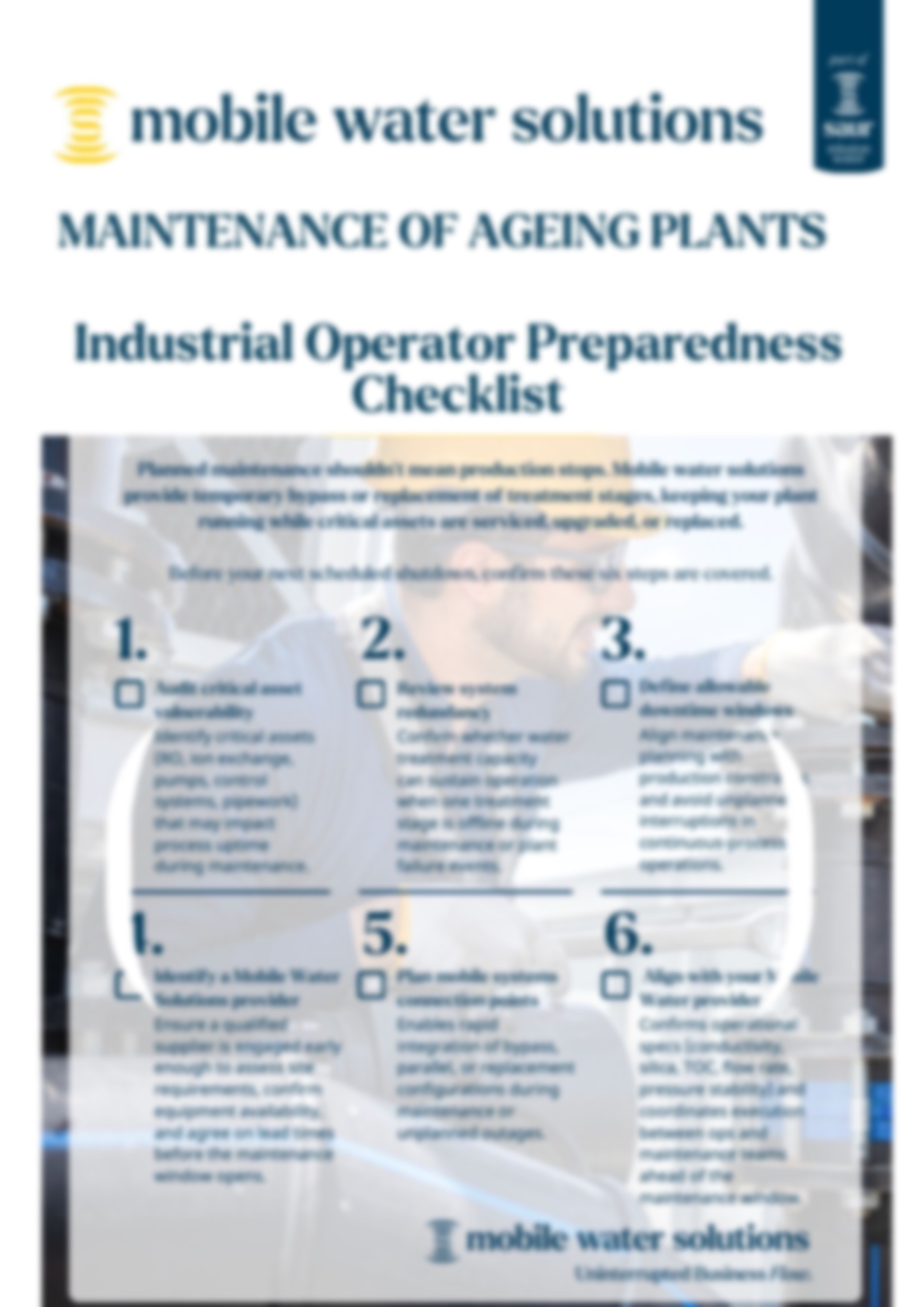
Why do ageing water treatment plants increase operational downtime risk?
As water treatment assets age, operational risk increases due to combined technical and operational constraints.
Most facilities experience:
• reduced redundancy in treatment trains
• longer and more frequent maintenance cycles
• tighter coupling between water systems and production processes
• limited flexibility to schedule shutdowns
“Besides increasing failure probability, ageing reduces maintenance flexibility, which becomes the key limiting factor in industrial uptime management.”
How mobile water systems are deployed in ageing water treatment plants
Mobile water systems are modular, containerised or skid-mounted treatment units designed to temporarily replace, supplement, or bypass sections of an industrial water treatment plant when permanent infrastructure cannot support operational continuity during maintenance, failure, or capacity constraints.
In ageing water treatment plants, their use is driven by a structural reduction in operational flexibility. As redundancy decreases and systems become more tightly integrated with continuous production, even planned maintenance activities can create direct conflicts with uptime requirements.
Mobile water systems are deployed as temporary process infrastructure to maintain compliant water supply while specific treatment stages are taken offline, allowing production processes to continue during maintenance without interruption to downstream operations. Their function is to decouple maintenance activities from production continuity requirements in continuous-process systems.
Deployment typically occurs when the cost or risk of downtime exceeds acceptable operational thresholds in continuous industries such as refining, petrochemical production, power generation, and chemical manufacturing.
Typical triggers include:
- Planned maintenance exceeding allowable shutdown windows
- RO membrane replacement or cleaning requiring system isolation
- Ion exchange resin replacement in low-redundancy systems
- Unplanned failures in critical water treatment units
- Feedwater variability that ageing systems cannot buffer
“The governing constraint is always the same: reduced maintenance flexibility in ageing infrastructure where production cannot be interrupted.”
How mobile water systems maintain operational continuity during maintenance
When a permanent treatment plant is taken offline for maintenance, the mobile water system temporarily replaces its hydraulic function within the process train.
The system is connected upstream or downstream depending on plant configuration and maintains continuous flow of treated water to downstream users such as boilers or process units.
This ensures that downstream demand is met while the offline unit is isolated, cleaned, or replaced. The continuity is achieved through temporary substitution of process capacity rather than process optimisation.
Throughout switchover and operation, hydraulic stability, flow matching, and water quality compliance are maintained to ensure uninterrupted continuous-process performance.
How are mobile water treatment assets integrated into existing plants?
Integration depends on hydraulic conditions and plant design. Three configurations are used:
1. Full replacement mode
A complete treatment stage (e.g. RO system) is temporarily replaced.
2. Parallel operation mode
Mobile systems operate alongside existing equipment to stabilise flow or water quality.
3. Bypass continuity mode
Specific sections are isolated while mobile units maintain downstream supply.
All configurations require control of:
- Flow rate compatibility (m³/h alignment)
- Pressure stability
- Water quality consistency (conductivity, silica, TOC)
What is the real cost of downtime in industrial production?
Industry benchmarks (Siemens, McKinsey, Aberdeen) indicate that downtime in continuous-process industries typically ranges from:
- $10,000 to $500,000 per hour depending on sector
- up to $1 million per hour in high-criticality refining and petrochemical operations
These figures reflect general production downtime in continuous-process industries where critical utilities are part of the overall plant infrastructure and directly impact operational continuity.
What is the operational value of mobile water systems during maintenance?
Mobile water systems provide operational continuity in continuous-process industries by enabling maintenance of water treatment assets without interrupting downstream production processes.
This reduces exposure to high-impact production losses associated with downtime in critical industrial operations.
Key benefits:
- maintenance can proceed under controlled operating conditions
- downstream production remains continuously supplied
- process risk is managed through operational decoupling between maintenance and production systems
Case study: refinery RO maintenance without production shutdown
Context and operational constraint
A multinational oil and gas facility required temporary support for its demineralised water system during a planned turnaround and subsequent start-up phase.
Continuous supply of treated water was required to support maintenance activities and production restart operations. In such conditions, water supply becomes a critical continuity constraint when plant operations are partially or fully suspended.
Operational requirement
During start-up, the refinery required redundancy in demineralised water supply:
• 100 m³/h operational capacity
• 100 m³/h standby capacity operating in parallel with the existing plant
This configuration ensured stability during a high-sensitivity operational phase where maintenance and restart activities ran in parallel.
Solution and execution
A mobile water treatment system in a four-trailer configuration was deployed to support turnaround and start-up operations.
The system was integrated in parallel with the existing demineralised water plant and designed to meet strict water quality specifications:
• conductivity < 0.1 µS/cm
• silica (SiO₂) < 10 ppm
Key execution elements included:
• parallel integration with existing treatment infrastructure
• redundancy configuration (operational + standby capacity)
• controlled commissioning during turnaround window
Outcome and engineering insight
The system ensured continuous supply of demineralised water throughout the intervention period, supporting both maintenance and start-up operations without disruption.
This mitigated risk associated with turnaround delays and maintained process stability during a critical operational phase.
Turnaround and maintenance phases require temporary redundancy in water systems to decouple equipment downtime.
The Bottom Line: Resilience Is a Choice
Conclusion: maintaining continuity in ageing water treatment plants
In ageing water treatment plants, operational risk increases as redundancy decreases and systems become more tightly integrated with continuous production, reducing the ability to perform maintenance without disrupting operations.
Mobile water systems address this constraint by temporarily restoring operational independence at critical points in the treatment chain. This allows maintenance activities to be executed under controlled conditions while maintaining water supply within specification, transforming maintenance from a production-disrupting event into a managed engineering operation.
Discuss temporary mobile water systems for maintenance, continuity planning, and plant downtime reduction.
Speak to our experts
Frequently Asked Questions (FAQs): Mobile Water Systems in Ageing Water Treatment Plants
1. What is the main limitation of ageing water treatment plants?
The main limitation is reduced maintenance flexibility, not just increased equipment failure.
2. Are mobile water systems a permanent replacement?
No. They are temporary infrastructure used to maintain continuity during maintenance, failure, or capacity constraints.
3. How quickly can mobile water systems be deployed?
Deployment time depends on site preparation, but typically ranges from hours to a few days in pre-engineered setups.
4. Can mobile water systems fully replace an RO system?
Yes, temporarily. They are commonly used to replace RO trains during maintenance or membrane replacement.
5. What is the main engineering value of mobile water systems?
Operational decoupling between maintenance activities and continuous production processes.